Author

Plane Marketing Team
Last Update

Table of Contents
Loading headings...
You’ve set up a U.S. company. You own meaningful equity. You’re doing the work. Now comes the deceptively simple question that turns out to be full of edge cases: how do you pay yourself?
For international founders, the right answer depends on a few realities: where you physically perform the work, the stage of the business, and what you need to look like under investor due diligence. Let’s walk through the options, including what’s required vs. recommended.
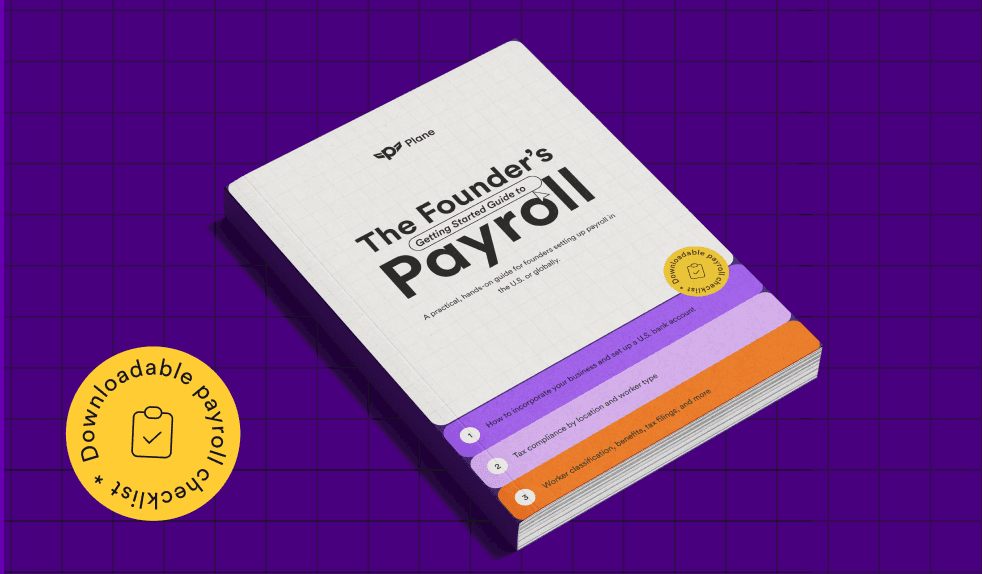
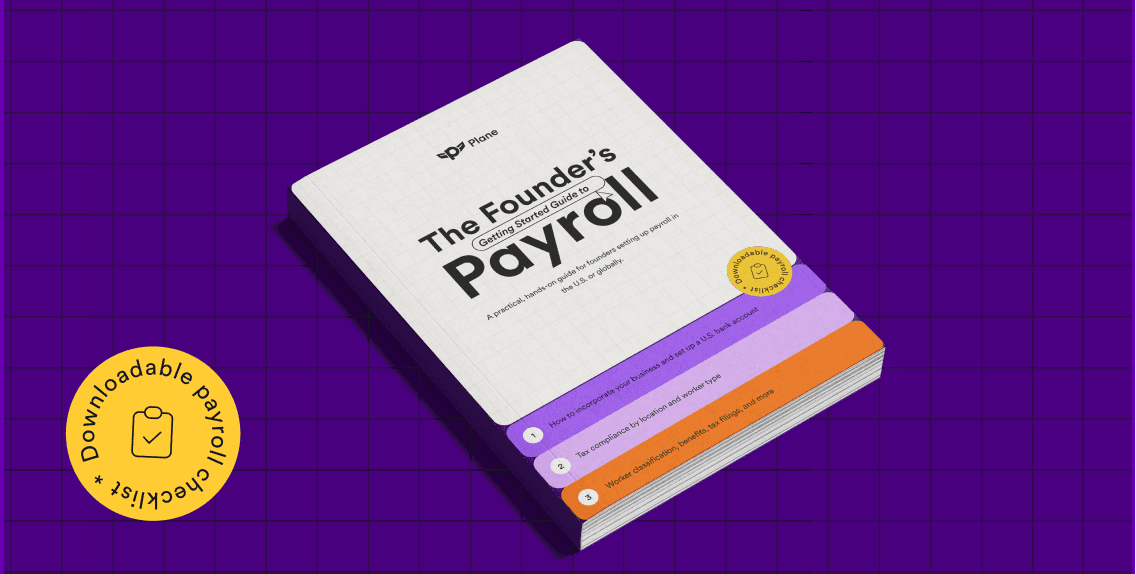
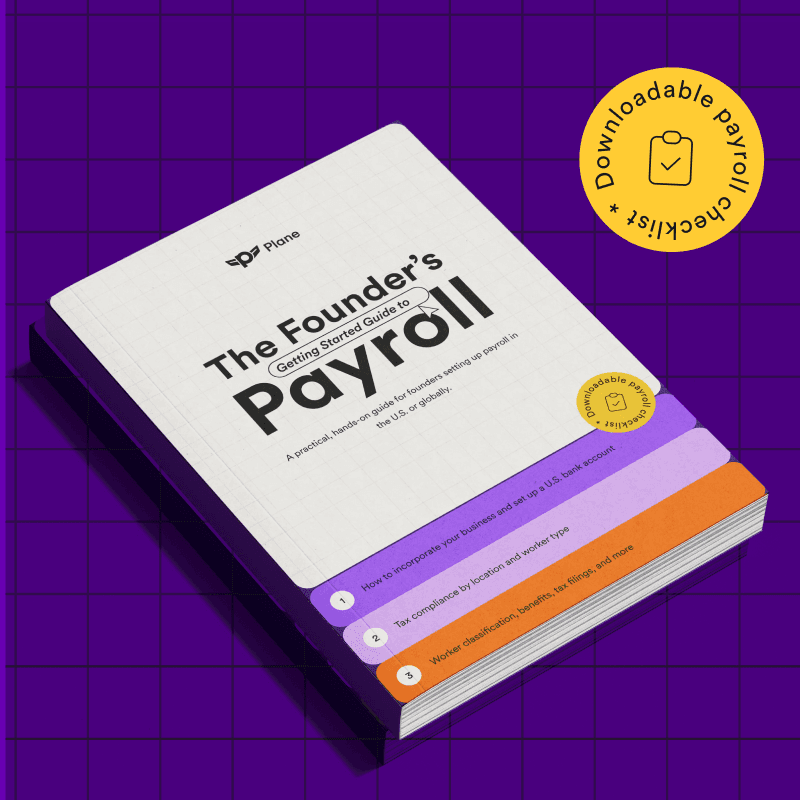
Understanding payroll from day one.
Read our Founder’s Guide to Getting Started.
The four ways founders usually get paid (and what each one really means)
Most international founders end up in one (or a mix) of these approaches:
Salary (W-2 employee)
Contractor payments (typically when work is performed entirely outside the U.S.)
No salary (at least for a while)
Expense reimbursements (legitimate business expenses only, not compensation)
Each can be workable. Each can also go sideways if it doesn’t match the facts on the ground.
Option 1: Take a salary as a W-2 employee
If you’re living in the U.S., W-2 payroll is the cleanest approach. The IRS position is straightforward: corporate officers are generally employees, unless they perform no services or only minor services and receive no pay or entitlement to pay. The IRS lays that out directly in its guidance on paying yourself.
Required
If you pay yourself W-2 wages, you’re signing up for employment tax mechanics. The IRS is explicit that employers must withhold and deposit income tax, Social Security, and Medicare, and also pay the employer portion of Social Security and Medicare, plus unemployment tax where applicable. That baseline requirement is summarized in the IRS’s employee vs. independent contractor guidance.
Recommended
Put the decision in writing
Treat founder compensation like any other corporate decision: approve it formally and keep a paper trail (board minutes or written consent). It’s not about bureaucracy; it’s about showing the company acted intentionally and consistently, especially when you’re fundraising or going through diligence.
Run payroll through a payroll system
Founders often try to “just wire themselves money” and sort it out later. Working with a payroll provider prevents that drift by ensuring the correct withholdings, deposits, and filings are completed on schedule.
What “reasonable compensation” means (in plain terms)
If you’re both a shareholder and an employee, pay needs to look like something the company would pay an unrelated person for similar work under similar circumstances. That’s the core idea behind “reasonable compensation.”
For C corporations, the risk isn’t usually “you paid yourself too little.” The classic issue is the opposite: if compensation is too high, the IRS may treat excess wages as non-deductible dividends.
Option 2: Get paid as a contractor (typically only when you have no U.S. presence)
This is the option many international founders want to use early because it feels operationally simple: send invoices, get paid, keep moving.
It can be viable in a narrow set of situations — especially when you live outside the U.S., perform services outside the U.S., and do not enter the U.S. to do the work. A good summary of the sourcing principle is that compensation for services is generally sourced to where the services are performed, and that non-U.S. individuals are generally subject to U.S. tax only on U.S.-source income.
The same resource notes that, as a practical result, no U.S. withholding would apply to compensation paid to a non-U.S. independent contractor when (1) the person is not a U.S. tax resident and (2) none of the services are performed while present in the U.S.
Required
Collect and retain Form W-8BEN
If you pay foreign individuals as contractors, you generally need documentation on file in the form of a W-8BEN. This form is typically kept in your records rather than filed with the IRS.
Common but risky
Misclassification
The IRS is clear that if you classify a worker as an independent contractor without a reasonable basis, you can be held liable for employment taxes.
In founder-land, the risk is practical: if you control the company, set strategy, work full-time, and operate like an executive, calling yourself a “contractor” can look like a label applied for convenience rather than a description of the relationship. That’s the sort of thing that can become a big headache during diligence.
Option 3: Take no salary (especially early)
Many founders go through an initial stretch where they simply don’t pay themselves. In the earliest days, that can be normal, particularly when the company has little cash, and everything is going back into product and hiring.
The caution is that “no salary” is not a permanent operating model. Over time, especially once you have outside investors or multiple founders, it can create an avoidable mess: uncertainty about wage claims, inconsistent treatment across founders, and awkward conversations later when you try to “catch up.”
Recommended
Document the decision
If you’re not paying salary, record it as an intentional decision (board minutes/written consent). “We didn’t get around to it” reads very differently from “we made a documented decision given runway and stage.”
Revisit when fundraising starts
Investors typically want comfort that there aren’t outstanding wage issues lurking. Wage claims — real or alleged — can become a diligence thorn.
Common but risky
Unpaid minority founders
The risk spikes when there’s a founder who isn’t in control and isn’t being paid. If that person is later terminated and unhappy, they may pursue wage claims, even if success is uncertain. Again, this is the kind of situation that can be disproportionately distracting for an early-stage company.
Option 4: Reimbursements only (fine for expenses, not fine as “salary by another name”)
Expense reimbursements can and should exist alongside any of the above, but reimbursements aren’t compensation. They’re simply the company paying you back for legitimate business expenses you covered personally.
Required
Keep reimbursements legitimate and documented. You want receipts, a clear business purpose, and consistent handling.
Also, when reimbursements are properly treated under an accountable plan, certain travel and lodging reimbursements to a non-U.S. individual providing independent services are not subject to withholding.
Common but risky
Two patterns cause problems fast:
Running personal living expenses through “reimbursements.”
Using reimbursements as a workaround for salary when the reality is you’re performing executive-level work and functionally acting as an employee.
If you need money to live, call it what it is and structure it properly. That’s almost always cheaper than cleaning it up later.
How much should you pay yourself?
This is the part founders want a crisp formula for — and the honest answer is that stage, runway, and investor expectations matter more than any single benchmark.
There are founder salary benchmarks floating around. For example, OpenVC summarizes typical founder salary ranges by stage (pre-seed through Series A). Startups.com also offers a practical view on early founder compensation norms and runway sensitivity.
Rather than anchoring on a single “correct” number, most teams do better with a simple operator rule:
If paying yourself increases existential risk (shortens runway below what you need), don’t do it yet.
If not paying yourself increases execution risk (you can’t focus, you’re forced into side work, you’ll burn out), then pay something modest and make it boring.
And whichever number you choose, make it board-approved and easy to defend.
International founder considerations that trip people up
1) Where you physically perform work matters
When compensation is tied to services, the location of service delivery will impact payment and tax considerations.
2) Entering the U.S. for work changes the analysis
If you perform services in the U.S., even in part, payments can become U.S.-sourced to some extent based on how much work was done while physically present in the U.S.
According to the IRS, 30% withholding may apply to payments to nonresident alien independent contractors unless they show proof of a withholding agreement with the IRS.
The operational takeaway is simple: if you’re regularly in the U.S. pitching, meeting customers, or working hands-on, treat that as a core fact in your compensation setup.
3) “Delaware C-corp” is common, but not universal
Many startups incorporate in Delaware, but not all do — and some start elsewhere and convert later. Regardless of state, once you have a U.S. corporation, you’re in a world of ongoing filings and tax compliance. The details vary by entity type and state.
If you are a Delaware corporation specifically, Delaware’s Division of Corporations is clear that domestic corporations have annual report and franchise tax obligations due on or before March 1, with penalties and interest for late filing.
Corporate tax and state obligations don’t pause just because you didn’t pay yourself
Founder compensation decisions don’t exist in isolation. Even if you take no salary, your company may still have filing obligations.
Once incorporated as a Delaware C Corporation, you generally still need to file corporate taxes even in years with no activity, and Delaware franchise tax obligations can apply regardless of income or expenses.
(If you’re not a Delaware corporation, the concept still holds — filings don’t go away — but the exact requirements depend on your state and entity.)
A practical decision framework
Your situation | What usually makes sense |
Pre-revenue, bootstrapping, solo founder | No salary can be workable for a short period; document it |
Pre-revenue with multiple founders | Avoid “unpaid forever”; decide on minimums or a defensible structure and document it |
Post-funding (any stage) | Pay a modest salary, board-approved, via payroll if you’re operating as an employee |
Living outside the U.S., services performed entirely outside the U.S., no U.S. travel | Contractor payments may be possible with W-8BEN on file; be careful with classification |
Living in the U.S. or regularly working while in the U.S. | W-2 employment is typically the most applicable and most defensible |
What founders typically do next
Talk to a startup-experienced CPA, and if you’re international, make sure they’re comfortable with cross-border facts (travel, residency, treaties, sourcing).
If you’re taking wages, set up payroll and stop treating founder pay as an ad hoc transfer.
Document the compensation decision in board minutes or written consent — whether you pay yourself or intentionally don’t.
If using contractors, collect W-8BEN forms and keep them on file.
Review compensation at least annually, and also whenever you raise, change your work location pattern, or materially change your role.
Legal disclaimer: This guide provides general information for educational purposes and is not legal, tax, or financial advice. Founder compensation can involve complex tax and employment considerations that vary by jurisdiction. Consult qualified professionals for advice on your specific situation.
Want product news & updates?
Sign up for our newsletter.